
ICR, Stress Rates and Top-Slicing: How Much Can You Borrow on a Buy-to-Let?



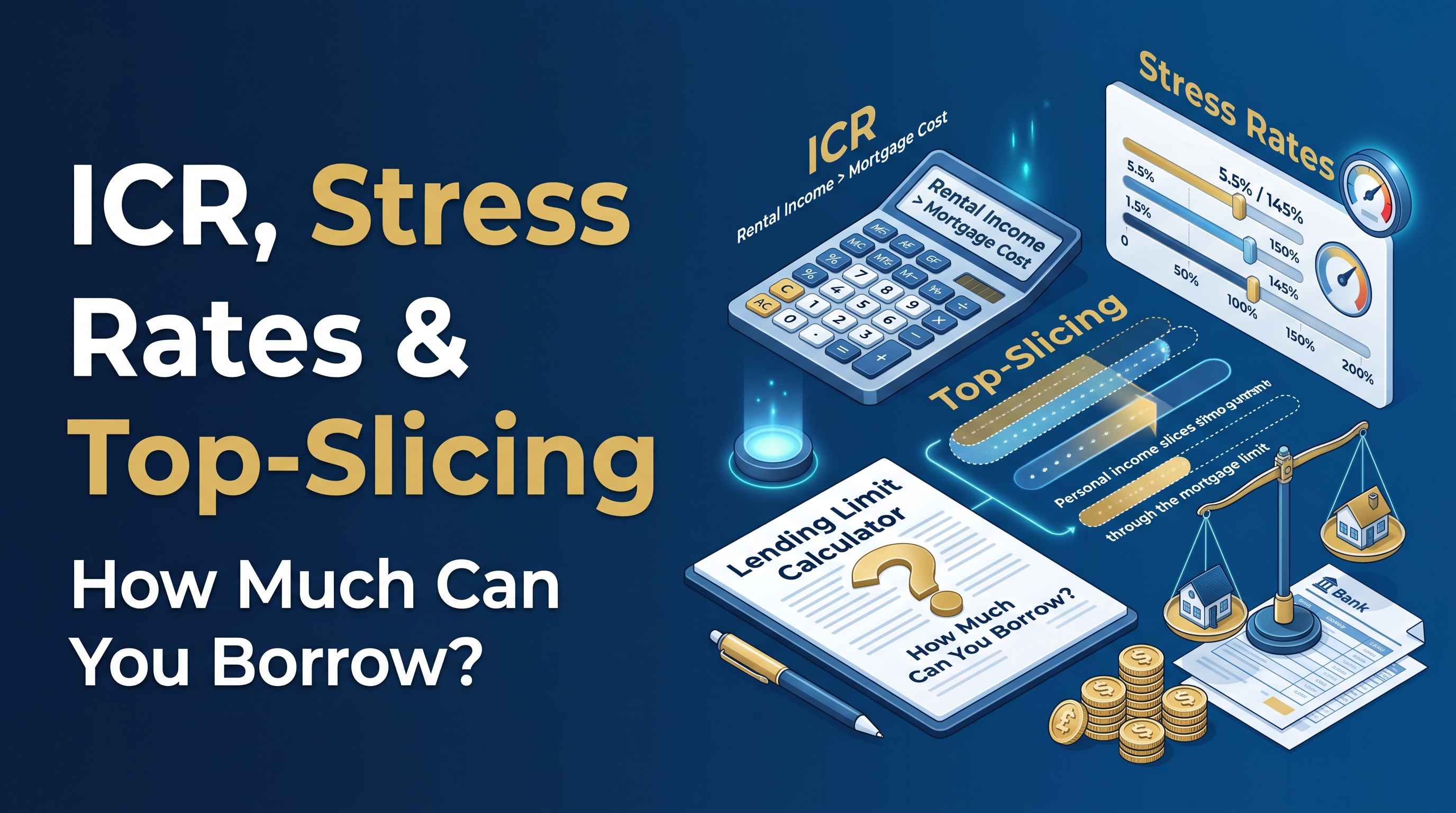
With a residential mortgage, your salary sets your borrowing. With a buy-to-let mortgage, the rent usually does. Lenders use a rental calculation called the interest coverage ratio (ICR), tested at a stress rate, to work out the maximum loan. Understanding the formula is the quickest way to see why two lenders can offer very different amounts on the same property.
The formula
Maximum loan = Annual rent ÷ (ICR × Stress rate)
ICR is the multiple of interest the rent must cover. 125% and 145% are the most common.
Stress rate is the interest rate the lender tests at. It is often higher than the rate you will actually pay.
Under Bank of England (PRA) rules, lenders must stress-test buy-to-let affordability. For fixes shorter than five years, they test at a rate well above the pay rate. For fixes of five years or more, many lenders test at the actual pay rate, which can raise your borrowing.
Why your tax band matters
Individual landlords cannot deduct mortgage interest from rental income; they get a basic-rate tax credit instead. Higher-rate taxpayers therefore keep less rent, so lenders often apply 145% to them and 125% to basic-rate taxpayers and limited companies. From April 2027, as announced in the 28 October 2026 Budget, property income tax rises again for individuals, which may push more lenders towards stricter ICRs for personal borrowers.
Worked example
A flat lets for £1,200 a month (£14,400 a year). All figures are illustrative.
Higher-rate taxpayer, 2-year fix, 145% ICR at 5.5% stress: maximum loan £180,564. Limited company, 2-year fix, 125% ICR at 5.5% stress: maximum loan £209,454. Limited company, 5-year fix tested at a 5.0% pay rate, 125% ICR: maximum loan £230,400.
Same flat, same rent, a £50,000 difference in borrowing.
Top-slicing: using your income to fill the gap
Some lenders let you use personal income to top-slice, topping up a rental shortfall. If the rent supports £180,000 but you need £200,000, your surplus income after tax and outgoings can cover the gap. Each lender sets its own minimum income and rules, and top-slicing is not available on every product.
Five ways to improve your borrowing
1. Choose a five-year fix where the lender tests at the pay rate. 2. Buy through a limited company if it suits your tax position: https://www.dynesourcer.co.uk/blog/complex-btl/limited-company-buy-to-let-mortgage-2026 3. Use top-slicing with lenders that offer it. 4. Put down a larger deposit to reduce the loan you need. 5. Get an accurate rental valuation. The lender uses the surveyor's figure, not the agent's asking rent.
Run your numbers
The Dynesourcer complex BTL calculator shows rental cover, monthly payments and true cost for interest-only and repayment.
Compare buy-to-let borrowing in the complex BTL calculator. HMO, MUFB, MPOT, short-term let, holiday let and other specialist property types all use this same tool.
https://www.dynesourcer.co.uk/mortgages/complex-buy-to-let-mortgage-calculator
For standard single-let buy-to-let mortgages:
https://www.dynesourcer.co.uk/mortgages/buy-to-let-mortgage-calculator
FAQs
What is a good ICR for buy-to-let
Most lenders use 125% to 145%. Lower is better for the borrower.
Why is the stress rate higher than my rate
It checks the loan stays affordable if rates rise after your fixed period.
Does a five-year fix always let me borrow more
Often, but not always. It depends on the lender's stress approach.
Can I use my salary on a buy-to-let
Yes, with lenders that allow top-slicing.
Important information
Your property may be repossessed if you do not keep up repayments on your mortgage. Most buy-to-let mortgages are not regulated by the Financial Conduct Authority. Consumer buy-to-let mortgages, and mortgages where you or a close family member will live in the property, are regulated. Dynesourcer Ltd is an Introducing Appointed Representative of Dynamic Commercial Finance Ltd, which is authorised and regulated by the Financial Conduct Authority, FRN 946483. A broker fee may be payable on application; we will tell you the amount before you proceed. This article is general information, not personal advice or tax advice. Tax treatment depends on your individual circumstances and may change. Figures correct as at 29 October 2026.
Want tailored sourcing?
Use the calculator for your scenario, then move into sourcing to compare, shortlist and apply.