
HMO Valuations Explained: Bricks-and-Mortar vs Investment Value



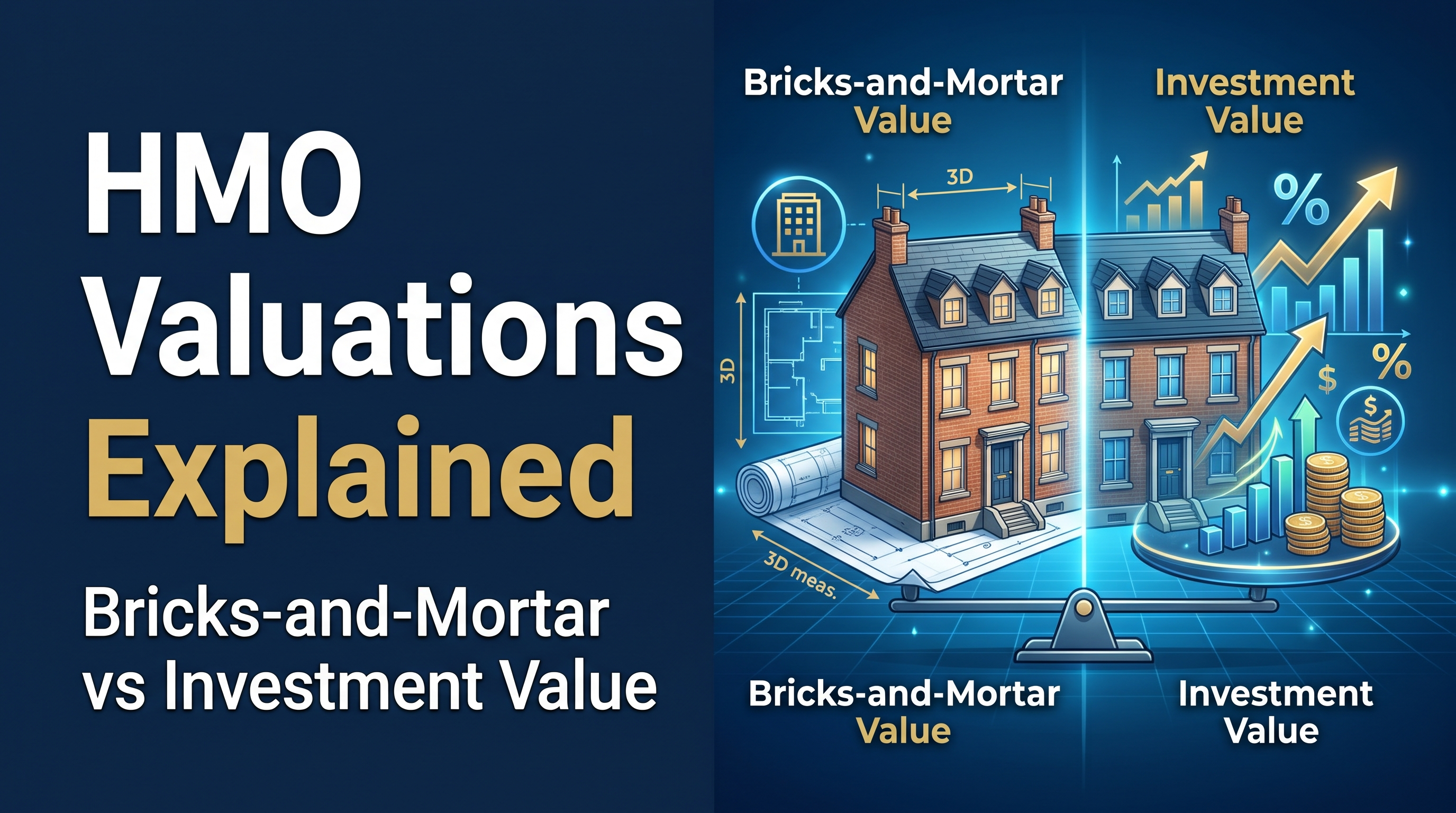
The same six-bed HMO can be valued at £250,000 by one lender and £400,000 by another. Neither surveyor is wrong. They are using different valuation methods, and the method decides how much you can borrow, how much cash you leave in the deal and whether a refinance works at all.
The two valuation methods
Bricks-and-mortar value is what the property would sell for as an ordinary house to an owner-occupier, ignoring its HMO income. The surveyor compares it with recent sales of similar family homes nearby.
Investment value (sometimes called commercial value) treats the HMO as an income-producing business asset. The surveyor takes the net annual income and applies a yield that reflects demand from HMO investors in that area.
Investment value = Net annual income ÷ Investor yield
Worked example
A licensed six-bed HMO lets at £550 per room per month. All figures are illustrative.
Gross rent (6 rooms × £550 × 12): £39,600 Less running costs at 30% (bills, management, voids, repairs): £11,880 Net annual income: £27,720 Investment value at an 8% yield: £346,500 Bricks-and-mortar value (local house sales): £240,000
At 75% loan-to-value, that is a maximum loan of £259,875 on investment value but only £180,000 on bricks-and-mortar. The difference of almost £80,000 is often what decides whether an investor can recycle their deposit.
Which lenders use which method
Most mainstream HMO lenders value on bricks-and-mortar, especially for small HMOs of three to six rooms. Specialist lenders are more likely to accept investment value, but usually only when:
• The HMO is licensed where a licence is required, with lawful planning use. • It has at least one to two years of trading history, ideally with accounts or a rent schedule. • It has six or more rooms, often with en-suites, in an area with proven HMO demand. • The borrower is an experienced HMO landlord.
A newly converted HMO with no letting history will rarely get full investment value on day one, even with a strong agent's projection.
What the surveyor checks
1. Room sizes and layout against licensing standards. Undersized rooms may be excluded from the income. 2. Rents achieved against local comparable rooms, not the rents you hope for. 3. Running costs, including bills, which HMO landlords usually pay. 4. Licence and planning, including any Article 4 direction. 5. Exit risk. If the HMO market weakened, could the property easily revert to a family home?
How to support a stronger valuation
• Have the licence, planning evidence and fire safety certificates ready for the surveyor. • Provide a full room-by-room rent schedule with tenancy start dates. • Keep accounts showing income and costs for at least a year. • Show local HMO comparables if you have them, such as sales of other licensed HMOs.
Plan your refinance
Run your HMO figures through the complex BTL calculator, selecting HMO as the property type, and check which valuation basis each lender uses before you apply.
Compare HMO valuations in the complex BTL calculator. HMO, MUFB, MPOT, short-term let, holiday let and other specialist property types all use this same tool.
https://www.dynesourcer.co.uk/mortgages/complex-buy-to-let-mortgage-calculator
For standard single-let buy-to-let mortgages:
https://www.dynesourcer.co.uk/mortgages/buy-to-let-mortgage-calculator
Read the HMO mortgage overview: https://www.dynesourcer.co.uk/blog/complex-btl/hmo-mortgage-guide-uk
FAQs
Why is my HMO valued so low
The lender is likely using bricks-and-mortar value. Ask whether a lender that accepts investment value would suit your case.
Can I get investment value on a new conversion
Rarely on day one. Most lenders want a trading history first.
What yield do surveyors use
It depends on local investor demand and the property. Higher yields mean lower values.
Does an HMO licence affect value
Yes. An unlicensed HMO that needs a licence is very hard to finance on any basis.
Important information
Your property may be repossessed if you do not keep up repayments on your mortgage. Most buy-to-let mortgages are not regulated by the Financial Conduct Authority. Consumer buy-to-let mortgages, and mortgages where you or a close family member will live in the property, are regulated. Dynesourcer Ltd is an Introducing Appointed Representative of Dynamic Commercial Finance Ltd, which is authorised and regulated by the Financial Conduct Authority, FRN 946483. A broker fee may be payable on application; we will tell you the amount before you proceed. This article is general information, not personal advice or tax advice. Tax treatment depends on your individual circumstances and may change. Figures correct as at 29 October 2026.
Want tailored sourcing?
Use the calculator for your scenario, then move into sourcing to compare, shortlist and apply.